TL;DR:
- True STEAM integrates science, technology, engineering, arts, and math through project-based, real-world problem solving.
- Effective STEAM education relies on clear methodologies like project-based, inquiry-based, and design-based learning.
- Successful implementation requires vision, teacher collaboration, equitable access, and authentic community partnerships.
Many administrators assume STEAM is just STEM with an art class tacked on. That assumption leads to programs that look good on paper but fail to move students. True STEAM, as defined by transdisciplinary, project-based learning, weaves science, technology, engineering, arts, and mathematics into unified learning experiences where students solve real problems. The result is not just more creative students. It is more capable, adaptable thinkers. This guide breaks down what STEAM really means, how to implement it well, and what to watch out for along the way.
Key Takeaways
| Point | Details |
|---|---|
| True STEAM is integrated | STEAM education meaningfully blends arts with STEM in a project-based, student-centered framework. |
| Effective strategies matter | Project-based, inquiry-driven, and design-based learning are the most successful for K-12 STEAM. |
| Equity and support are key | Successful STEAM programs prioritize access for all students, robust teacher training, and ongoing assessment. |
| Start with small pilots | Launching with pilot programs and scaling based on results leads to more sustainable STEAM implementations. |
What is STEAM education?
STEAM stands for Science, Technology, Engineering, Arts, and Mathematics. But the acronym alone does not capture what makes it powerful. The real difference is in how these subjects are taught together, not separately.
In a traditional STEM model, a student might learn physics in one class, coding in another, and math in a third. Each subject stays in its lane. STEAM breaks those lanes down. A student designing a bridge, for example, applies engineering principles, uses math to calculate load, writes a proposal using communication skills, and creates a visual model. The arts are not decorative. They are functional.
STEAM education involves transdisciplinary fusion, the engineering design process, and real-world challenge tackling. That means students are not just learning content. They are applying it in context, which is where deep understanding actually forms.
Here is what each discipline contributes to a STEAM learning experience:
- Science: Observation, hypothesis, and evidence-based reasoning
- Technology: Tools, systems, and digital literacy
- Engineering: Design, iteration, and problem-solving processes
- Arts: Communication, creativity, and aesthetic thinking
- Mathematics: Quantitative reasoning, measurement, and data analysis
The role of arts in STEAM is often the most misunderstood. Arts integration is not about drawing pictures after a science lesson. It is about using creative thinking as a core problem-solving tool. Students who sketch prototypes, compose data visualizations, or write persuasive arguments about engineering solutions are using the arts functionally.
| Feature | STEM | STEAM |
|---|---|---|
| Disciplines | 4 technical fields | 5, including arts |
| Learning approach | Subject-specific | Transdisciplinary |
| Student role | Receiver | Designer and creator |
| Assessment focus | Technical accuracy | Process and creativity |
| Real-world connection | Applied | Integrated and contextual |
“STEAM is not about adding art to STEM. It is about rethinking how all five disciplines work together to solve problems that matter.”
If you want to see how program learning goals connect to STEAM outcomes, it helps to map each activity to a specific skill set before you build a lesson or event.
Key methodologies and classroom practice
Knowing what STEAM is matters less than knowing how to teach it. The methodologies that make STEAM work are distinct from traditional instruction, and each one plays a specific role.
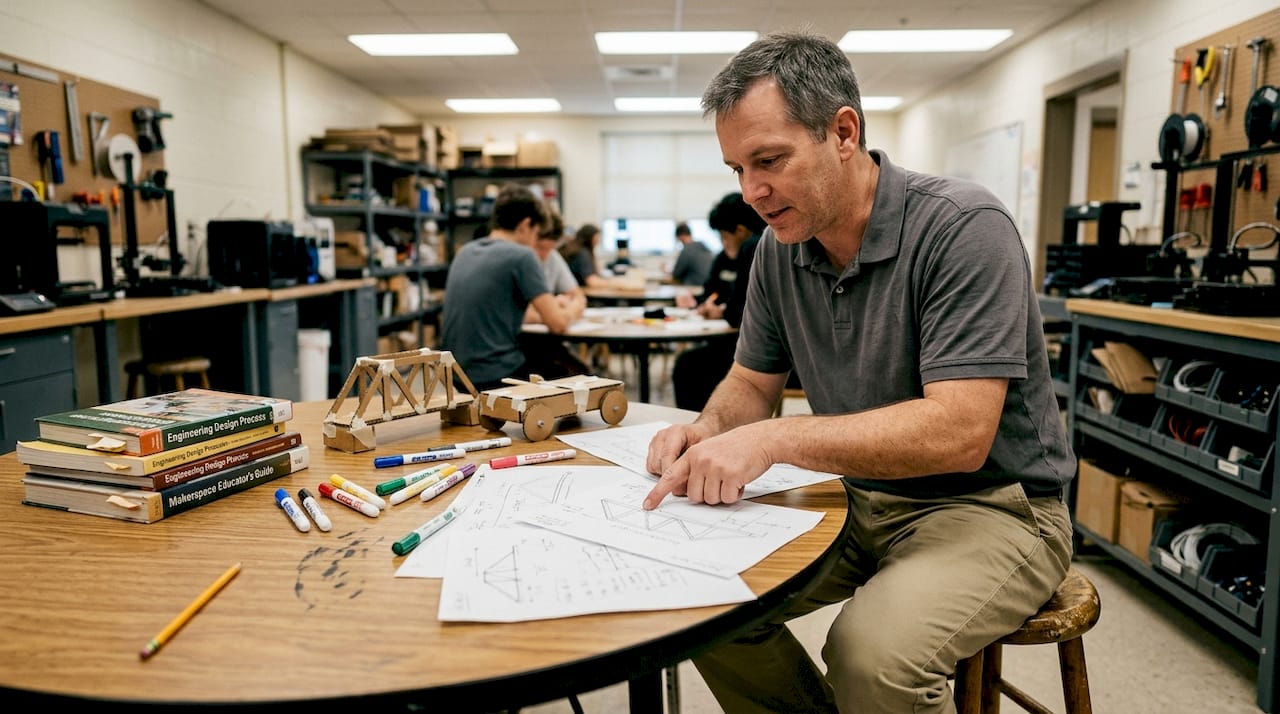
Project-based learning (PBL) is the backbone of most STEAM classrooms. Students work on extended projects that require them to research, design, build, and present. A third-grade class might design a community garden, combining biology, measurement, and visual design. A high school class might prototype a water filtration system, pulling from chemistry, engineering, and environmental science.
Inquiry-based learning starts with a question rather than an answer. Instead of telling students how photosynthesis works, a teacher asks: “Why do plants near the window grow faster?” Students design their own investigations. This builds scientific thinking and ownership of learning.
Design-based learning centers on the engineering design process. Students identify a problem, brainstorm solutions, build a prototype, test it, and refine it. The cycle repeats. Failure is expected and treated as data.
Project-based, design-based, and inquiry-based learning are central to STEAM because they integrate real-life applications rather than treating subjects as isolated units. That integration is what separates a STEAM lesson from a science lesson with a craft project.
Here is a practical sequence for introducing STEAM methodologies in your school:
- Start with a single cross-curricular project tied to a real community need
- Use the engineering design process as a shared framework across subjects
- Build in structured reflection time after each project phase
- Introduce inquiry prompts before delivering content, not after
- Celebrate process documentation, not just final products
- Use STEAM educational assemblies to spark curiosity before a unit begins
Pro Tip: Start with guided inquiry rather than open inquiry. Novice learners need structure before they can thrive with full independence. Give them a focused question and a clear investigation framework first, then gradually release control as their confidence builds.
Classroom scenarios help make this concrete. A fifth-grade class studying ecosystems might design a model habitat, write a persuasive letter to a fictional city council, and present their findings using a hand-drawn infographic. Every subject is present. None of them feel forced.
Implementing STEAM programs: Strategies and solutions
Building a STEAM program from the ground up requires more than enthusiasm. It requires a clear plan, committed leadership, and structures that support teachers over time.
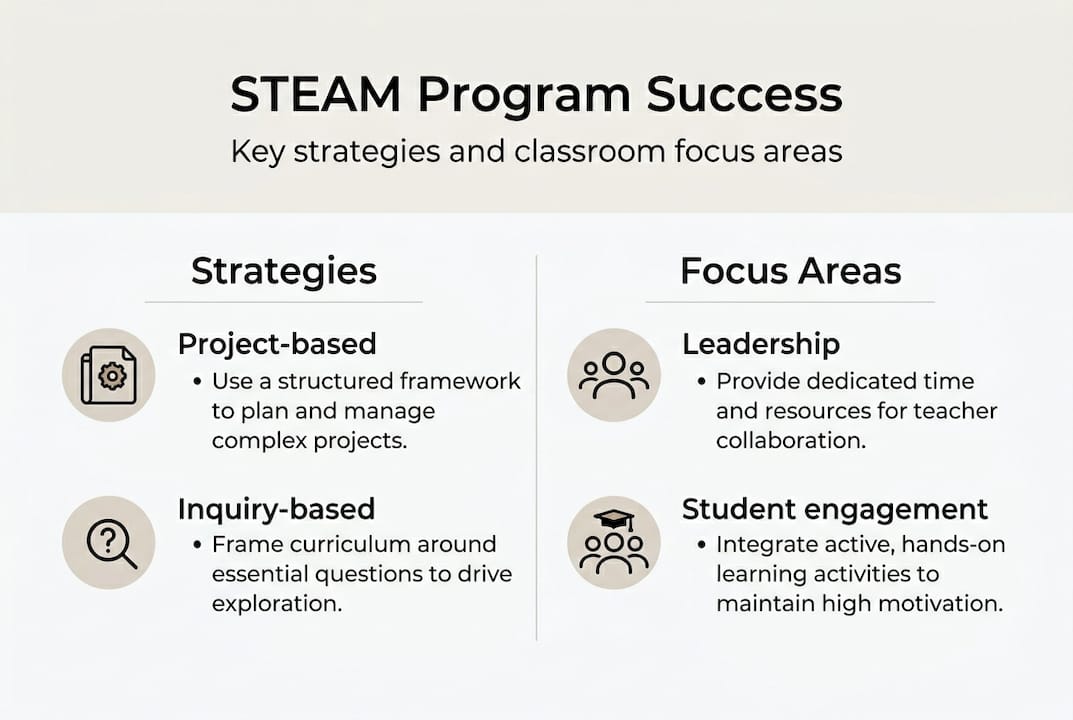
Administrators should focus on vision, equitable access, staff learning, and partnerships when implementing STEAM. That is not a checklist. It is a framework for sustainable change.
Here is what that looks like in practice:
- Vision and mission: Define what STEAM means for your school community. Write it down. Share it with staff, families, and students. A shared language prevents misalignment.
- Teacher professional development: Teachers cannot teach what they have not experienced. Invest in PD that models STEAM methodologies, not just explains them.
- Equitable access: STEAM cannot be reserved for gifted programs or well-funded schools. Every student deserves access to hands-on, integrated learning.
- Community and industry partnerships: Local engineers, artists, scientists, and makers can bring authenticity to STEAM projects that textbooks cannot.
- Planning tools: Use design thinking planners, rubrics, and student portfolios to track progress and guide instruction.
| Implementation component | Focus area | Key indicator of success |
|---|---|---|
| Vision | Leadership alignment | Staff can articulate STEAM goals |
| Instruction | Classroom methodology | PBL and inquiry are visible |
| Assessment | Student growth | Portfolios show iterative thinking |
| Equity | Access and inclusion | All learners participate fully |
| Partnerships | Community connection | Real-world problems drive projects |
Looking at STEAM program examples from schools that have already launched can save you significant planning time. You do not need to build everything from scratch.
Using a student engagement checklist during the planning phase helps ensure your program design actually connects with students, not just with curriculum standards.
Benefits and challenges of STEAM: The full picture
STEAM has real strengths. It also has real limitations. Understanding both helps you build a program that delivers on its promise.
On the benefits side, STEAM improves student engagement, builds interdisciplinary thinking, and creates space for students who do not thrive in traditional test-focused environments. Students who struggle with rote memorization often excel when given a design challenge. That is equity in action.
The arts benefits within STEAM are especially significant for students who need multiple entry points into learning. Creative expression lowers the barrier to participation and increases motivation across subject areas.
But the research is not one-sided. STEAM improves creative problem-solving but may reduce technical mastery, and risks include cognitive overload for novice learners. When students are asked to manage too many variables at once, learning can stall. This is called the expertise reversal effect, where strategies that help advanced learners can actually confuse beginners.
“The goal is not to make every student an artist or an engineer. It is to build thinkers who can move fluidly between disciplines.”
Studies suggest students in well-implemented STEAM programs show up to 34% higher creative problem-solving scores, while poorly scaffolded programs can see a 12% drop in technical mastery. The difference is almost always in the quality of implementation, not the model itself.
Here is a practical list of do’s and don’ts:
- Do scaffold complex projects with clear checkpoints
- Do connect arts education experiences to academic goals explicitly
- Do assess process and thinking, not just final products
- Don’t treat arts as decoration or a reward for finishing STEM work
- Don’t skip teacher preparation and expect strong outcomes
- Don’t launch district-wide before piloting and measuring results
Best practices and expert tips for K-12 STEAM success
The schools that sustain strong STEAM programs share a few common habits. They are not always the schools with the biggest budgets. They are the ones with the most intentional practices.
Start with teacher collaboration, pilot programs, and robust assessment before any district-wide STEAM rollout. That sequence matters. Skipping the pilot phase is the single most common mistake administrators make.
Here is a research-backed sequence for building STEAM that lasts:
- Form a cross-disciplinary teacher planning team before writing a single lesson
- Choose one grade level or subject area to pilot your first STEAM unit
- Use state toolkits and rubrics to guide design and assessment
- Collect student work samples and teacher reflections throughout the pilot
- Measure outcomes against your original STEAM vision and goals
- Scale what works, revise what does not, and document both
Pro Tip: Blend classroom instruction with live STEAM program pilots and performances. A well-designed assembly can generate the kind of curiosity and excitement that sustains a unit for weeks. Use it as a launch event, not an afterthought.
Equity must be built into every step. That means ensuring students with disabilities, English language learners, and students from under-resourced communities have the same access to hands-on STEAM experiences as their peers. Scaffolding is not optional. It is the mechanism that makes inclusion real.
For teachers who are newer to STEAM, tips for online learning environments can also support hybrid and remote STEAM delivery, especially for schools still balancing in-person and virtual instruction.
Our perspective: What most get wrong about STEAM education
After working with K-12 schools for over 40 years, we have seen one pattern repeat itself more than any other. Schools adopt STEAM as a label before they adopt it as a practice. They rename a science fair, add a makerspace, and call it a STEAM program. Then they wonder why nothing changes.
True STEAM is not a branding exercise. It is a mindset shift that asks teachers to collaborate across subject lines, asks administrators to protect time for that collaboration, and asks students to sit with uncertainty long enough to learn from it. That is uncomfortable. It is also where the growth happens.
The schools that get STEAM right treat it as a journey. They celebrate small wins, like a student who finally understands fractions because she used them to scale a design. They reflect honestly on what is not working. And they never stop asking whether every student has a real seat at the table.
Exploring real-world STEAM examples from schools that have done this work is one of the fastest ways to move from theory to action.
Bring STEAM to life in your school
Understanding STEAM is the first step. Bringing it to life in your building is where the real work begins, and you do not have to do it alone.
Academic Entertainment has supported K-12 schools for over 40 years with programs that spark curiosity and connect directly to learning goals. Our arts assemblies and STEM assemblies are designed to complement your classroom instruction, not compete with it. Whether you are launching a new STEAM initiative or looking to energize an existing one, our innovative school assemblies give students an experience that makes abstract concepts feel real and worth exploring.
Frequently asked questions
How does STEAM differ from STEM in practice?
STEAM adds the arts and focuses on interdisciplinary, real-world learning through project-based and inquiry-driven approaches, while STEM concentrates on technical disciplines taught in a more subject-specific way.
What are the biggest challenges in starting STEAM education?
Common challenges include shifting teacher mindsets, ensuring equitable student access, securing adequate resources, and achieving true integration rather than surface-level subject mixing.
Is STEAM effective for all student levels?
Yes, STEAM can engage all students, but scaffolding is essential for beginners. Without structured support, novice learners can experience cognitive overload rather than growth.
How do schools measure the success of STEAM programs?
Program rubrics and portfolios guide and assess STEAM implementation by capturing creativity, problem-solving, and iterative thinking rather than relying solely on test scores.
Can STEAM assemblies and performances help launch a program?
Absolutely. Blending STEAM programs and performances increases student engagement and gives teachers a memorable anchor point to build classroom instruction around.
Recommended
- STEAM Education: Transforming Learning in Trenton Suburbs – Academic Entertainment
- Energize Your Schools with STEAM Educational Assemblies. – Academic Entertainment
- Understanding Are Your Programs Tied to STEM/STEAM Learning Goals? – Academic Entertainment
- 7-Step Student Engagement Checklist for School Success – Academic Entertainment
- 3 Tips To Help You Better Acclimate To Online Learning