
Using Prop 28 to Fund Educational Assembly Shows
Understanding Proposition 28 and Its Purpose
California’s Proposition 28, officially known as the Arts and Music in Schools (AMS) Funding Guarantee and Accountability Act, provides a significant opportunity for schools to expand arts education and enrichment opportunities. While the primary intent of Prop 28 is to fund arts instruction—such as visual arts, music, dance, theater, and media arts—it also opens the door for schools to integrate high-quality educational assemblies into their programming. Partnering with providers like Academic Entertainment allows schools to creatively and compliantly use these funds to enhance student engagement while meeting the spirit and requirements of the law.
How Prop 28 Funding Can Support Assembly Programs
At its core, Prop 28 allocates ongoing funding to public K–12 schools specifically for arts and music education. These funds must supplement, not replace, existing arts and music funding and must be used for activities that directly support student access to the arts and music. Importantly, the law allows for flexibility in how schools deliver arts and music instruction, including through partnerships with outside organizations, teaching artists, and educational performance groups. This is where assembly providers like Academic Entertainment can play a valuable role.
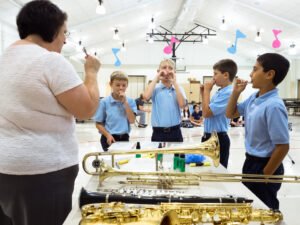
Academic Entertainment specializes in school assembly programs that blend education with performance, often incorporating elements of theater, music, storytelling, and multimedia. Many of these assemblies align closely with California Arts Standards and can be framed as arts-integrated learning experiences. For example, an assembly that uses live theater to teach history or a music-based performance that explores cultural traditions can qualify as arts education when tied to learning objectives and student outcomes. By carefully selecting programs that meet these criteria, schools can use Prop 28 funds to cover the cost of assemblies.
Aligning Assemblies with Arts Education Goals

To do this effectively, schools should begin by aligning assembly content with their arts education goals. Prop 28 emphasizes equitable access to arts learning for all students, so assemblies should be chosen not just for entertainment value, but for their instructional merit. Academic Entertainment offers a range of programs that can support this, such as performances focused on literacy through storytelling, science concepts through interactive theater, or social-emotional learning through music and character-driven narratives. When these programs are integrated into the school’s broader arts plan, they can be justified as part of a comprehensive arts and music education strategy.
Ensuring Compliance and Proper Documentation
Another key consideration is documentation and accountability. Prop 28 requires schools to report how funds are used and to ensure that expenditures directly support arts education. When booking an assembly through Academic Entertainment, schools should request detailed program descriptions, learning objectives, and standards alignment. This documentation can then be included in funding reports and shared with administrators or district officials to demonstrate compliance. Additionally, schools may consider incorporating pre- and post-assembly activities—such as classroom discussions, art projects, or reflective writing—to further reinforce the educational value of the performance.
Collaborating with Educators and Assembly Providers
Collaboration between school staff and assembly providers is also essential. Teachers, arts coordinators, and administrators should work together to identify gaps in their current arts offerings and determine how assemblies can address them. For instance, if a school lacks a dedicated theater program, a series of theatrical assemblies could introduce students to performance arts in an accessible way. Academic Entertainment can often customize or recommend programs based on a school’s specific needs, making it easier to align with Prop 28 goals.
Promoting Equity Through Arts Access
Equity is another important aspect of Prop 28. The funding formula is designed to ensure that schools with higher proportions of low-income students receive additional resources. Using these funds for assemblies can help bring high-quality arts experiences to students who might not otherwise have access to live performances or cultural programming. Academic Entertainment’s assemblies can serve as a gateway to the arts, sparking interest and creativity in students from diverse backgrounds. Schools can further support equity by ensuring that all grade levels have access to these programs and by selecting culturally responsive content that reflects the student population.
Strategic Budgeting for Maximum Impact
Budgeting strategically is also key. While Prop 28 funds can be substantial, they must cover a range of arts-related expenses, including staff salaries, materials, and programs. Schools should plan their budgets so that assemblies are one component of a balanced arts program. For example, a school might allocate a portion of its funds to hire a part-time arts instructor and another portion to bring in assemblies throughout the year. Academic Entertainment can often provide flexible pricing or package options, allowing schools to maximize the impact of their funding.

Communicating Value to School Community
Finally, communication with the school community is crucial. Parents, school boards, and community members may not immediately understand how assemblies fit into arts education funding. Schools should clearly articulate how these programs support student learning, align with standards, and enhance the overall educational experience. Sharing photos, student feedback, and outcomes from Academic Entertainment assemblies can help build support and demonstrate the value of using Prop 28 funds in this way.
Conclusion: Bringing Arts Education to Life
In conclusion, Proposition 28 provides California schools with a powerful tool to expand and enrich arts education. By thoughtfully integrating assembly programs from providers like Academic Entertainment, schools can create engaging, standards-aligned experiences that meet funding requirements while inspiring students. With careful planning, documentation, and collaboration, assemblies can become a meaningful and compliant use of Prop 28 funds, helping to bring the arts to life for every student.
Frequently Asked Questions
Can Prop 28 funds legally be used for school assemblies?
Yes, Prop 28 funds can be used for assemblies as long as the programs support arts education and align with California Arts Standards. Assemblies must have clear instructional value—such as incorporating theater, music, or storytelling—and not be purely for entertainment.
What types of assembly programs qualify under Prop 28 guidelines?
Qualifying programs typically include performances that integrate visual or performing arts with educational content. Examples include theatrical productions tied to curriculum, music-based cultural programs, or interactive storytelling that supports literacy and creativity.
How can schools ensure assemblies meet Prop 28 compliance requirements?
Schools should request documentation from providers like Academic Entertainment, including learning objectives, standards alignment, and program descriptions. Additionally, integrating pre- and post-assembly classroom activities can strengthen the educational connection.
Can assemblies replace traditional arts instruction funded by Prop 28?
No, Prop 28 funds must supplement existing arts education, not replace it. Assemblies should be part of a broader arts plan that may also include instructors, materials, and ongoing programs to ensure a well-rounded arts education experience.