

School assemblies can easily become a routine that students dread rather than anticipate. Finding ways to spark genuine excitement, build community, and inspire your entire student body in a single gathering is no small task. The right assembly can transform your school climate, but the wrong one leaves everyone counting the minutes until dismissal.
The good news is there are proven approaches that go far beyond passive presentations. From hands-on science experiments that make abstract concepts real to comedy and cultural performances shown to support social cohesion and character development, creative assemblies offer you powerful tools for student engagement. When assemblies connect with students’ experiences and learning styles, every child gets a chance to feel included and motivated.
If you want your next school assembly to do more than fill time, you’ll want to see these dynamic options. Each one brings real, actionable benefits that teachers can reference in classrooms for weeks to come. Get ready to discover how the right assembly can ignite curiosity, unite your school, and leave a lasting impact on your students.
Quick Summary
| Takeaway | Explanation |
|---|---|
| 1. Engage Students with Experiential Learning | Interactive assemblies like Wacky Science make science tangible, boosting student curiosity and engagement in classrooms. They see science as exciting and accessible. |
| 2. Use Humor to Build Community | Laugh Factory assemblies leverage comedy to foster connections among students, breaking social barriers and enhancing the school culture through shared laughter. |
| 3. Connect Reading to Real-Life Adventures | Adventures in Reading assemblies inspire students to pursue literacy by bringing stories to life, making reading appealing and relevant to their lives. |
| 4. Make Healthy Choices Relevant | Supermarket Science assemblies teach students about nutrition by directly linking concepts to everyday food, empowering them to make informed eating choices. |
| 5. Promote Character Development through Assembly Themes | Character Counts assemblies inspire positive behaviors and foster a sense of community by reinforcing core values that students can relate to and apply daily. |
1. Wacky Science: Sparking Curiosity Through Experiments
Wacky Science assemblies transform the auditorium into a laboratory where students become active participants rather than passive observers. These high-energy programs showcase real scientific phenomena through hands-on demonstrations and interactive experiments that capture imaginations and ignite genuine curiosity about how the world actually works.
The power of this assembly style lies in making abstract scientific concepts tangible. When students witness dry ice bubbling over, watch chemical reactions create unexpected colors, or see electricity arc in dramatic fashion, something clicks in their minds. Science stops being vocabulary words in a textbook and becomes something they saw with their own eyes, felt in the air, or even touched themselves. This shift from passive learning to experiential engagement fundamentally changes how students perceive science and their own potential as problem solvers. School administrators know that when students leave an assembly buzzing with excitement about experiments, that energy carries forward into their regular science classrooms. Teachers report improved student engagement in lab activities for weeks after Wacky Science visits because the assembly establishes that science is genuinely cool and accessible.
What makes these assemblies particularly valuable for diverse student populations is their universal language. Students who might struggle with traditional lecture formats connect through visual demonstrations and sensory experiences. English language learners grasp scientific concepts through observation rather than linguistic explanation. Students with different learning styles all find entry points through the combination of dramatic presentation, humor, and interactive elements. The experiments themselves teach the scientific method in action without feeling like instruction. Students naturally see hypothesis testing, observation, data collection, and drawing conclusions as scientists demonstrate why predictions sometimes surprise us. This creates teachable moments where your staff can later reference the assembly and deepen classroom learning through structured lab work and science fair project ideas that build on concepts introduced during the show.
Implementing Wacky Science assemblies also supports your school’s character development and anti-bullying initiatives. When students cheer together at a scientific demonstration, when they laugh at the same moment of wonder, when they’re all equally amazed by what they see happening on stage, you’re building school community. This shared experience creates common ground across grade levels and social groups. Students who might not normally interact find conversation starters in what they witnessed. The excitement around a visiting scientist assembly often becomes a unifying force that breaks down social barriers, reinforces inclusion, and demonstrates that being curious and excited about learning is something everyone can embrace together.
Pro tip: Request that the Wacky Science presenter connect demonstrated experiments to concepts your curriculum covers in specific grade levels, so teachers can immediately reference the assembly in their lesson plans and extend the learning through classroom follow-up activities.
2. Laugh Factory: Building Community and Character with Comedy
Laugh Factory assemblies harness the universal power of humor to create moments of genuine connection and laughter that ripple through your entire school community. These programs combine comedy performances with positive character messages, turning a simple assembly into a catalyst for building stronger relationships among students, staff, and school culture.
When students laugh together, something powerful happens beneath the surface. Research shows that comedy and cultural performances in schools promote social cohesion and create inclusive environments that build relationships among diverse student populations. Shared laughter breaks down barriers that typically separate different friend groups, grade levels, and social cliques. A sixth grader sitting next to a fourth grader, both laughing at the same joke, are experiencing community in action. Students who might normally keep to themselves find themselves laughing alongside peers they might not otherwise interact with. This shared experience of joy creates common ground and reminds students that they all belong in the same school community. For schools working on anti-bullying initiatives, Laugh Factory assemblies become particularly valuable because humor delivered with kindness demonstrates how to use comedy to build others up rather than tear them down.
Beyond the immediate fun, comedy assemblies reinforce character development in subtle but meaningful ways. Skilled comedians know how to weave messages about resilience, kindness, and making good choices into their humor. When a performer talks about handling mistakes or treating others with respect and gets genuine laughs in response, students internalize those messages differently than they would from a classroom lecture. The positive emotions associated with laughter actually help students retain the character lessons more effectively. Your students leave the assembly not just entertained but genuinely inspired to apply what they learned. Teachers report that students reference jokes and messages from Laugh Factory assemblies for months afterward, making it easier to reinforce character education during regular instruction. For schools serving diverse student populations, these assemblies create moments where every student feels included and valued, which directly supports your inclusive school environment goals.
Pro tip: Ask the performer to reference specific character themes your school is emphasizing that year, such as kindness, perseverance, or respectful communication, so the comedy connects directly to your broader school culture initiatives and extends into classroom discussions afterward.
3. Adventures in Reading: Making Literacy Come Alive for All Ages
Adventures in Reading assemblies transform reading from a skill students must master into an experience they genuinely want to pursue. These dynamic performances bring stories, characters, and the magic of literature off the page and into the gymnasium where students of all ages see reading as an adventure worth taking.
Literacy is the foundation for everything else your students will learn, yet many struggle with motivation and engagement. Adventures in Reading assemblies address this challenge by showing students that reading opens doors to incredible worlds, thrilling plots, and characters they care about. When a skilled performer brings a beloved book character to life, when students hear the actual voices and emotions behind the words on a page, something shifts in their perception. They begin to understand that reading is not just decoding words but experiencing stories. This is particularly valuable for struggling readers and English language learners who benefit from seeing how engaging pre-reading activities build motivation and background knowledge before diving into texts independently. The assembly itself becomes that motivational entry point that makes students want to pick up books in their classrooms and libraries.
For elementary and middle school administrators, these assemblies offer a practical way to align entertainment with literacy standards. The programs connect to your existing curriculum while adding theatrical energy that typical classroom instruction cannot match. Students who have watched an Adventures in Reading performance often become more engaged during guided reading groups and independent reading time because the assembly planted the seed that stories matter. Teachers report increased library checkouts and more enthusiastic participation in literature discussions following these assemblies. The inclusive nature of performance based literacy engagement means students with different reading levels all find value in the assembly. A student reading two grade levels below still gets to experience the joy and excitement of narrative. A gifted reader gets to see advanced literature brought to life. Everyone leaves the assembly with the same message that reading is worth their time and energy.
These assemblies also strengthen your anti-bullying and character development work by featuring stories that emphasize kindness, acceptance, and standing up for what is right. When students see characters overcome challenges through courage and compassion, they internalize those values as part of their own story.
Pro tip: Coordinate with your literacy specialists before the assembly to identify specific grade level books or themes the performer should highlight, then have classroom teachers follow up with guided reading activities, book discussions, or independent reading assignments that extend the enthusiasm generated by the performance.
4. Supermarket Science: Bringing Healthy Choices to Life
Supermarket Science assemblies make nutrition education tangible by connecting what students learn about healthy eating to the actual foods they encounter every day in grocery stores and school cafeterias. These engaging programs transform abstract nutrition concepts into concrete, relatable lessons that students can immediately apply to their own food choices.
Many students struggle to connect nutrition information to real life decisions. They know they should eat healthy, but when faced with colorful packaging and appealing snacks, they often default to whatever tastes good in the moment. Supermarket Science assemblies bridge this gap by making the science behind food choices visible and exciting. Through interactive demonstrations, students learn how to read nutrition labels, understand what different nutrients do for their bodies, and recognize marketing tactics that influence food choices. When a presenter shows the actual amount of sugar in popular drinks or explains how their bodies use different nutrients for energy, growth, and brain function, students gain the knowledge they need to make informed decisions. This approach aligns perfectly with your school’s health and wellness initiatives while teaching critical thinking skills about consumer choices. The assembly experience stays with students far longer than a typical health class lecture because the information is presented in an entertaining, memorable way that captures their attention.
What makes Supermarket Science particularly valuable for your diverse student population is that it meets students where they are. Whether a student comes from a family that shops at local markets, large supermarkets, or convenience stores, the assembly acknowledges real food environments they navigate. Students see that making healthy choices doesn’t require special foods or expensive options but rather understanding how to make smart decisions with whatever foods are available. Teachers report that students become more engaged in school lunch lines and ask better questions about ingredients after these assemblies. The program also strengthens character development by encouraging students to consider how their food choices affect their bodies and their ability to focus, participate in sports, and succeed academically. Additionally, hands-on activities like food tastings and cooking experiences have proven effective for engaging students in nutrition education, and Supermarket Science assemblies create that interactive excitement around healthy eating.
Pro tip: Coordinate with your school cafeteria staff before the assembly to identify specific foods served in your lunch program that the presenter can reference, then have cafeteria workers highlight those healthy options in the days following the assembly so students can apply what they learned.
5. Mathical Mystery Tour: Exciting Critical Thinking with Math
Mathical Mystery Tour assemblies transform mathematics from a subject about memorizing procedures into an adventure in logical reasoning and problem solving. These interactive performances present mathematical concepts through engaging mysteries and puzzles that require students to think critically, test hypotheses, and discover solutions using mathematical thinking.
Many students view math as disconnected from real problem solving. They see it as rules to follow and procedures to memorize rather than a tool for understanding the world. Mathical Mystery Tour assemblies change this perspective by presenting math as the key to solving actual problems. When students watch a presenter work through a mystery using logic, pattern recognition, and mathematical reasoning, they see that math isn’t about getting right answers on worksheets but about thinking strategically to figure things out. The assembly models exactly what research shows works best for math instruction, which is developing problem solving strategies and mathematical reasoning rather than focusing solely on computation. Students leave the assembly understanding that mathematicians are detectives who use logical thinking to uncover patterns and solve puzzles. This reframes math as something creative and exciting rather than intimidating or boring.
For your school, these assemblies provide significant value for multiple student populations. Struggling math students gain confidence from seeing that math is about thinking and trying different approaches, not about being instantly correct. Gifted math students get intellectually stimulated by complex puzzles and creative problem solving. English language learners benefit from seeing mathematical concepts presented visually and logically, with fewer language barriers than typical word problems. Students who typically avoid math suddenly become engaged because the assembly presents mathematics as a mystery to solve together rather than a subject to endure. Teachers report that students who watched Mathical Mystery Tour ask more questions about how problems work and show greater persistence when facing challenging math activities. The experience demonstrates that wrestling with difficult problems is normal and valuable, which directly supports character development around perseverance and growth mindset. By connecting math to mystery and adventure, these assemblies help students see themselves as capable problem solvers who can use mathematical thinking to tackle real world challenges.
Pro tip: Coordinate with your math specialists before the assembly to identify specific problem-solving strategies or number concepts your students struggle with, then have the presenter emphasize those approaches so the assembly directly supports your current math curriculum instruction.
6. Culture and Diversity Connections: Fostering Inclusion
Culture and Diversity Connections assemblies celebrate the rich backgrounds and identities of your students while building genuine understanding and respect across cultural lines. These programs bring authentic cultural performances, stories, and perspectives into your school community, creating powerful moments where every student sees their heritage valued and peers gain appreciation for cultures different from their own.
Students thrive when they see themselves reflected in school experiences and when they feel their identities matter. For students from underrepresented backgrounds, cultural assemblies send a clear message that their heritage is important and worth celebrating alongside everyone else. For students from majority cultures, these assemblies build empathy and understanding by introducing them to perspectives and traditions they might not encounter otherwise. Research confirms that inclusive learning environments that recognize diverse identities improve academic outcomes and foster belonging for all students. When cultural assemblies authentically represent different communities through live performance, storytelling, and direct engagement, students form genuine connections with cultural traditions and the people who keep them alive. A student watching a traditional dance performed by someone from that culture learns something far more meaningful than reading about it in a textbook. They see the pride in the performer’s face, hear the music played with authentic instruments, and witness the living tradition in action. This transforms abstract knowledge about diversity into real human connection.
These assemblies directly address your school’s inclusion and anti-bullying goals by normalizing and celebrating differences. When students understand that different doesn’t mean wrong and that diversity makes communities stronger, they’re less likely to exclude, mock, or bully peers who are different from them. Students who previously felt isolated or invisible because their culture wasn’t reflected in school become more confident and engaged. Their peers develop genuine curiosity about backgrounds different from their own instead of seeing difference as something to fear or avoid. Teachers report improved classroom dynamics and stronger peer relationships following cultural assemblies because students have shared experiences to reference and common ground built on mutual respect. The assembly becomes a touchstone moment where your entire school community acknowledges and celebrates what makes each person unique while reinforcing that everyone belongs. For schools serving diverse populations, this creates an environment where students bring their whole selves to school and feel accepted and valued.
Pro tip: Before the assembly, provide teachers with cultural context and discussion prompts so they can prepare students beforehand and facilitate meaningful conversations afterward that deepen understanding and help students make personal connections to the cultural traditions presented.
7. Character Counts: Programs Promoting Positive Behaviors
Character Counts assemblies provide your school with a powerful tool for reinforcing the values and behaviors you want to see every day in hallways, classrooms, and on playgrounds. These programs go beyond simply telling students to behave well by inspiring them to understand why positive character matters and empowering them to make good choices when no one is watching.
Schools succeed when students embrace positive values and take responsibility for their own behavior. Rather than relying solely on punishment for misbehavior, Character Counts assemblies build intrinsic motivation by helping students understand that respect, fairness, responsibility, and integrity benefit everyone, including themselves. When students see characters they admire demonstrating these values through stories and examples they can relate to, something shifts. They begin to see character not as rules imposed from above but as a path to better relationships, stronger friendships, and personal success. Research confirms that character education emphasizing core values like respect and responsibility optimizes students’ ethical behavior and prepares them for future leadership. The assembly becomes a catalyst for conversations across your entire school community about what good character looks like in action. Teachers can reference the assembly messages when addressing behavior concerns, reinforcing that students already understand why positive choices matter.
What makes Character Counts assemblies particularly valuable is their ability to reach all students simultaneously with a consistent message. Your school can align the assembly with whatever character traits or values you are emphasizing that year, whether that’s kindness, perseverance, honesty, or inclusion. Students who rarely get recognized for academic achievement may shine in discussions about character. Quieter students see themselves reflected in examples of integrity and thoughtfulness. Students who struggle behaviorally see a clear path toward redemption and positive change rather than feeling labeled as troublemakers. The assembly establishes that character development is something everyone is working on together, reducing stigma and building community. For schools implementing PBIS or anti-bullying initiatives, Character Counts assemblies provide the motivational element that helps behavior expectations stick. Students who feel inspired about building good character and making positive contributions are far more likely to support those goals consistently. Teachers report noticeably improved behavior in the weeks following these assemblies, with students referencing messages they heard and making better choices during difficult moments.
Pro tip: Have teachers follow the assembly with classroom discussions where students identify real examples of the character values presented, then challenge them to actively demonstrate those values throughout the week and report back on their experiences.
Below is a comprehensive table summarizing the various educational assemblies and their suggested benefits as discussed in the article.
| Assembly Program | Description | Key Benefits |
|---|---|---|
| Wacky Science | Interactive science demonstrations making concepts tangible. | Enhances student engagement, builds curiosity, and creates a fun, memorable learning experience. |
| Laugh Factory | Comedy performances intermixed with positive character messaging. | Fosters inclusivity, reinforces character-building lessons, and promotes school-wide social cohesion. |
| Adventures in Reading | Performances transforming literature into engaging, interactive experiences. | Encourages reading enthusiasm, supports literacy development, and aligns with educational curriculum standards. |
| Supermarket Science | Nutrition-focused presentations connecting healthy choices to everyday life. | Educates on nutritional decision-making, supports health initiatives, and engages diverse student demographics. |
| Mathical Mystery Tour | Presenting math skills through puzzles and logical challenges. | Enhances critical thinking, reframes math as problem-solving, and inspires a growth mindset among students. |
| Culture and Diversity Connections | Cultural programs promoting understanding and respect among diverse groups. | Celebrates diversity, fosters empathy, and creates an inclusive school environment. |
| Character Counts | Programs emphasizing positive values and behaviors. | Teaches core ethical values, improves student behavior, and complements anti-bullying and PBIS initiatives. |
Spark Lasting Excitement in Your School with Engaging Assemblies
The article highlights a common challenge many educators face keeping students motivated and connected to learning across subjects like science, math, reading, health, and character education. It shows how assemblies that transform abstract concepts into memorable, hands-on experiences can overcome disengagement and build a positive school community. Whether it is sparking curiosity through “Wacky Science,” fostering inclusion with cultural stories, or strengthening character with positive role models, these programs address your goals of boosting student engagement, supporting diverse learners, and reinforcing school values.
At Academic Entertainment, we offer a diverse range of educational assembly programs curated to make learning fun and impactful. Our lineup of live and virtual shows can be tailored to your school’s themes and curriculum needs—bringing real-world lessons on topics like anti-bullying, health, diversity, and character development directly to your students. Join schools nationwide that benefit from our four decades of experience in creating assemblies that inspire participation, build community, and leave students eager to learn more. Explore our full program offerings and discover how easy it is to book the perfect event on our main site.
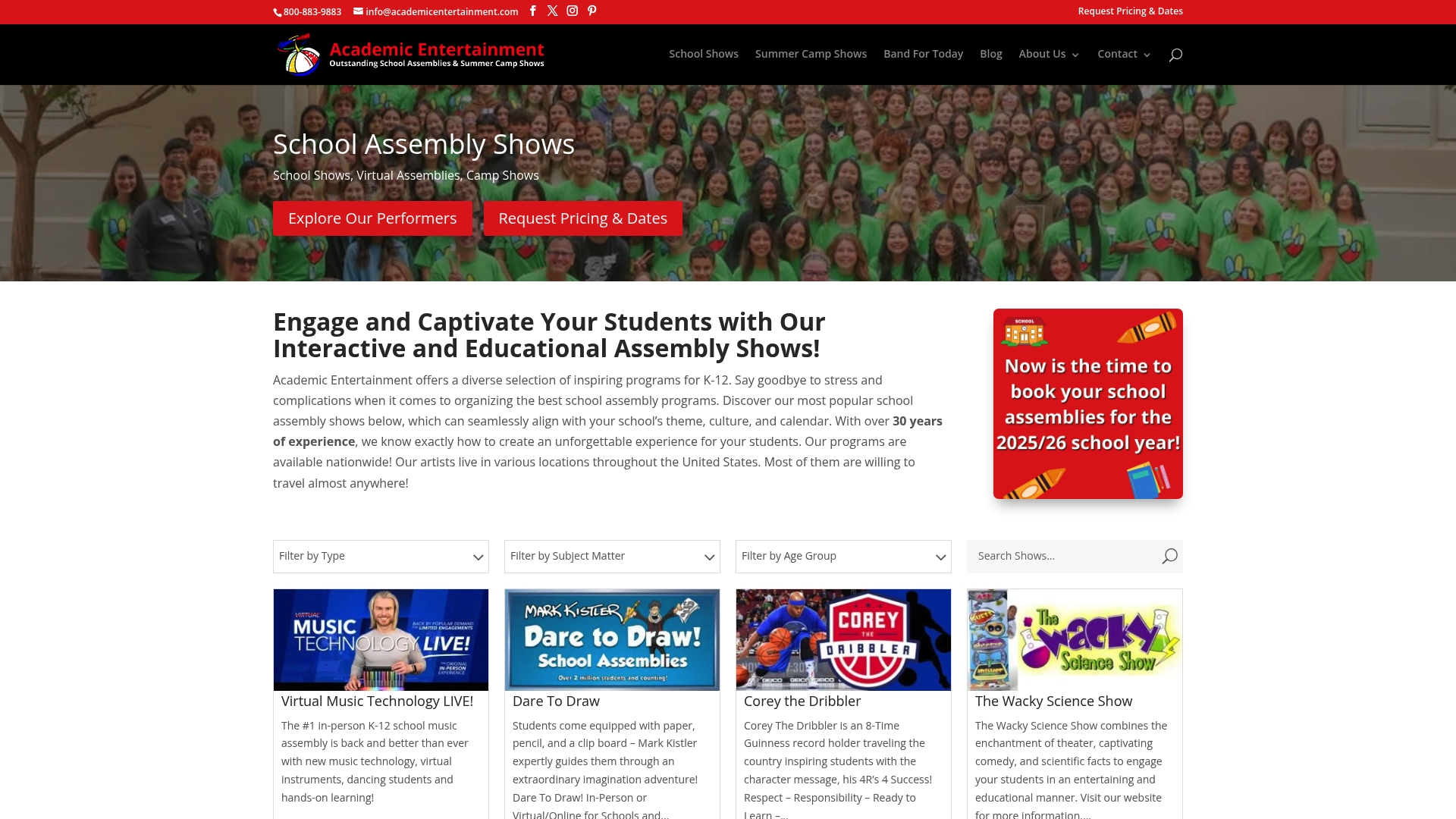
Ready to transform your next school assembly into an unforgettable learning adventure? Visit Academic Entertainment’s homepage now to explore shows that align with your instructional goals and engage every learner. Don’t wait to make your school’s next assembly the highlight of the year with captivating performances that excite and educate all at once.
Frequently Asked Questions
What types of assemblies are available to make learning fun in Seattle schools?
Wacky Science, Laugh Factory, Adventures in Reading, Supermarket Science, Mathical Mystery Tour, Culture and Diversity Connections, and Character Counts are all engaging options. Explore these assemblies to find the best fit for your school’s focus on making learning enjoyable and memorable.
How can I implement a school assembly in my classroom?
Start by discussing your school’s goals for student engagement and learning. Then, reach out to assembly providers to identify programs that align with those objectives, setting a date for when you want the assembly to occur.
What is the impact of school assemblies on student engagement?
School assemblies significantly increase student engagement by transforming learning into interactive experiences. Teachers have reported improved participation in related classroom activities within weeks after these assemblies.
How can we enhance the learning experience after a school assembly?
Follow up on the assembly by incorporating related discussions and activities into your lesson plans. For example, use guided reading or hands-on experiments connected to the assembly content within 30–60 days to reinforce learning.
Are these assemblies suitable for all age groups?
Yes, assemblies like Adventures in Reading and Supermarket Science are designed to engage students of all ages, from elementary through middle school. Choose assemblies based on your specific grade levels to maximize relevance and impact.
Can school assemblies support character development and anti-bullying initiatives?
Absolutely! Programs like Character Counts and Laugh Factory incorporate lessons on respect, kindness, and inclusivity, reinforcing these values in a fun, memorable way. Commit to regularly integrating these themes into classroom discussions and activities for sustained impact.
Recommended
- How to Make School Assemblies Even More Fun – Academic Entertainment
- What Makes Your Assemblies Different from Others? Explained – Academic Entertainment
- Best K-5 School Assemblies For Engagement In Phoenix – Academic Entertainment
- Understanding Why Book Educational Assemblies for Schools – Academic Entertainment


