

School assemblies have a reputation problem. Too many administrators still picture rows of restless students staring at a stage, passively absorbing information they’ll forget by lunch. But up to 30% higher engagement is what schools consistently report when they replace passive formats with intentional, interactive assembly shows. That gap is not a small difference. It represents a fundamental shift in how students connect with content, with each other, and with their school community. This article breaks down what makes interactive assemblies work, what the evidence says about their outcomes, and how you can choose the right program for your students.
Key Takeaways
| Point | Details |
|---|---|
| Higher engagement | Interactive assembly shows engage students up to 30 percent more than traditional assemblies. |
| Lasting learning impact | These assemblies can improve information retention by as much as 60 percent. |
| Supports whole-child development | Students build critical thinking, social, and emotional skills through participation. |
| Builds positive school culture | Over 80 percent of teachers say assemblies help unite students and staff. |
What Makes an Assembly Show Interactive?
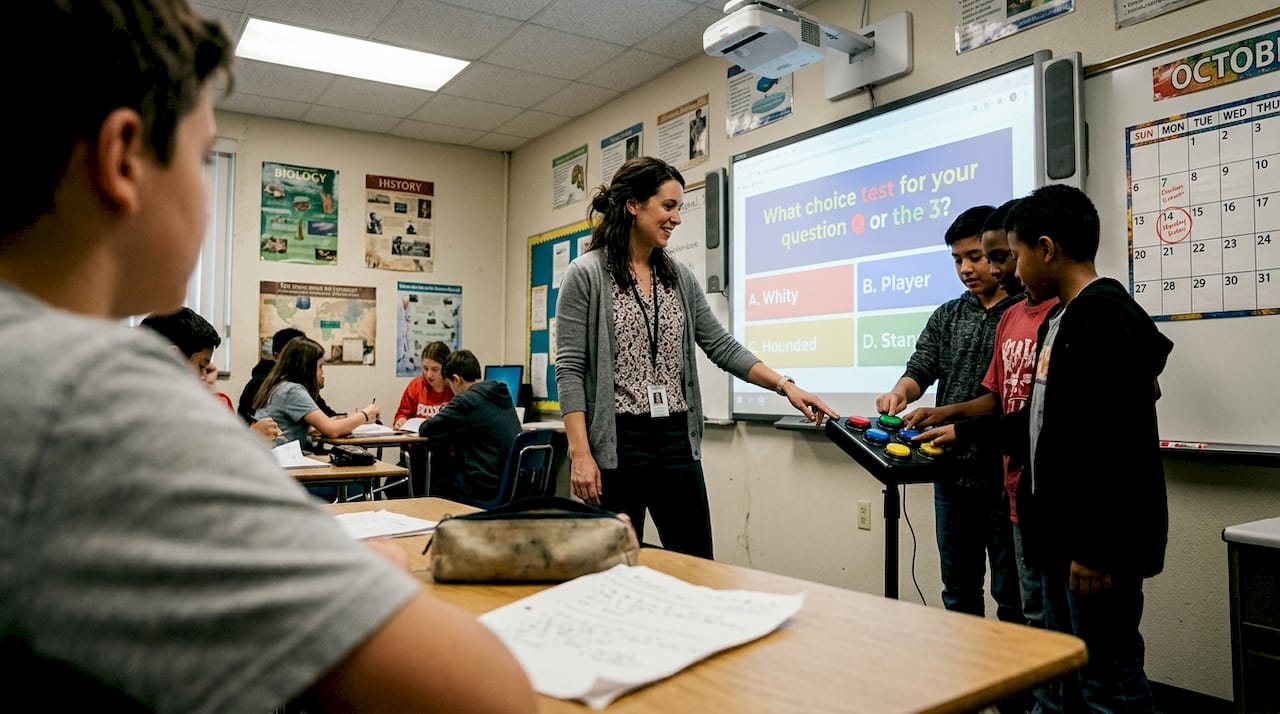
An interactive assembly program is not simply a show where a performer occasionally asks the audience a question. It is a structured, participatory experience designed to pull students into the learning process rather than position them as spectators. The difference between a traditional assembly and an interactive one is the difference between watching a cooking show and actually cooking.
The core mechanisms that define what makes assemblies interactive include a range of deliberate engagement strategies:
- Audience participation: Students are called on, invited to the stage, or asked to respond in real time
- Multisensory experiences: Programs incorporate sound, movement, visuals, and tactile elements to activate multiple learning pathways
- Real-time problem-solving: Students work through challenges or scenarios during the show itself
- Call-and-response formats: Rhythmic or verbal exchanges that keep energy and attention high
- Hands-on demonstrations: Students interact directly with props, experiments, or performance elements
- Multimedia integration: Video, music, and digital tools reinforce the program’s core message
These audience participation and multisensory elements are not just entertaining add-ons. They are the engine of learning.
“When students move from passive observers to active participants, their brains process information differently. Multi-sensory activation and real-time feedback create stronger neural connections, which means better retention and more meaningful engagement with the content.”
Understanding the shift from passive to interactive assemblies helps you see why the format itself matters as much as the content being delivered.
Why Schools are Making the Shift: Evidence-Based Outcomes
With the foundational elements established, let’s see what research reveals about real-world results. The numbers are hard to ignore.
Interactive formats boost information retention by up to 60% compared to traditional lecture-style presentations. Pair that with the 30% engagement advantage, and you have a compelling case for rethinking your assembly calendar.
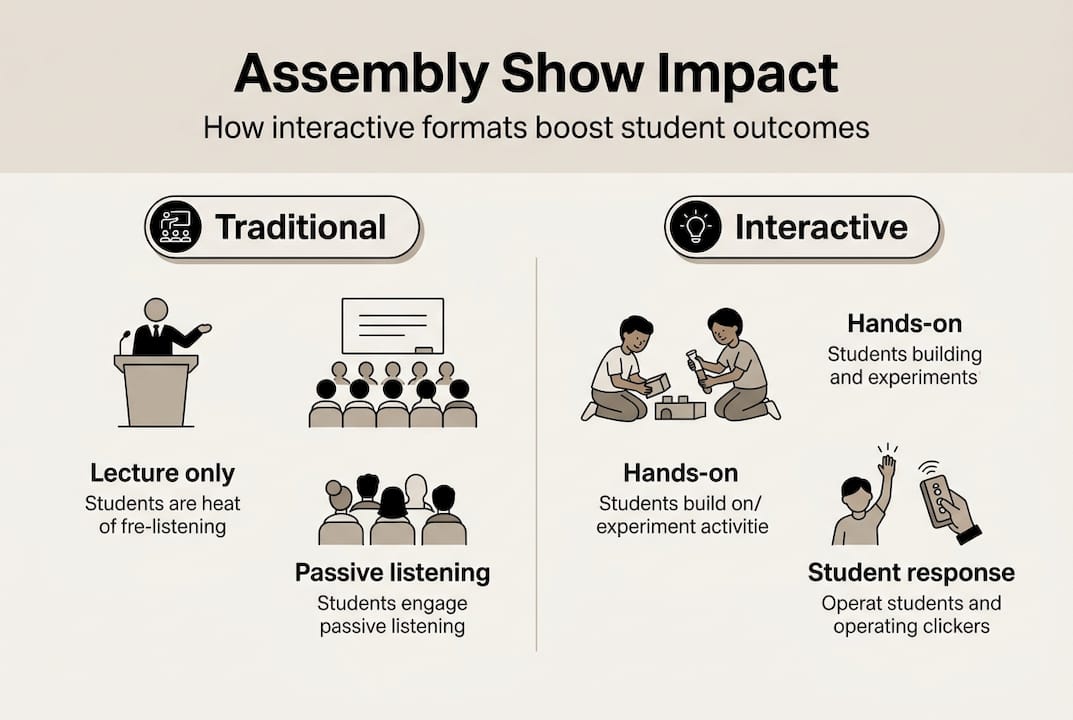
| Metric | Traditional assembly | Interactive assembly |
|---|---|---|
| Student engagement | Baseline | Up to 30% higher |
| Information retention | Baseline | Up to 60% higher |
| Active participation | Minimal | High |
| Post-event recall | Low | Significantly improved |
| Social skill development | Incidental | Intentional |
The benefits extend well beyond test scores and recall rates. Interactive assemblies foster holistic development across multiple dimensions, including communication skills, social-emotional intelligence, critical thinking, cultural awareness, and intrinsic motivation. These are exactly the competencies that educators and parents want schools to nurture, and they are difficult to build through passive instruction alone.
Strategies for engaging students in assemblies consistently point to one truth: when students feel seen and involved, they learn more and behave better during the event itself.
Pro Tip: Align your assembly content to your school’s current instructional themes. A science-focused interactive show scheduled during a STEM unit reinforces classroom learning and gives students a real-world context for what they are studying. This kind of intentional scheduling turns a single assembly into a curriculum multiplier.
Schools that treat assemblies as education through entertainment report stronger connections between assembly content and classroom follow-up activities, which compounds the learning benefit over time.
Impact on School Culture and Community
Beyond academic metrics, interactive assemblies also make a lasting impact on campus culture. This is where the value becomes harder to quantify but impossible to ignore.
More than 80% of teachers report that assemblies help build community and positive school culture. That is a remarkable level of professional consensus. When teachers see assemblies as culture-building tools rather than schedule interruptions, the entire school benefits.
Here is what interactive assemblies consistently deliver for school communities:
- Collaboration: Students work together during activities, building teamwork skills in a low-stakes environment
- Cultural awareness: Programs that celebrate diversity expose students to perspectives and traditions outside their own experience
- School spirit: Shared experiences create shared identity, which strengthens belonging and reduces isolation
- Inclusion: Well-designed interactive programs invite every student to participate, not just the confident or outgoing ones
- Staff and student connection: When teachers participate alongside students, it humanizes the relationship and builds trust
“Thoughtfully planned assemblies have the power to unite students and staff around shared values and experiences. They are one of the few moments in a school year when the entire community gathers with a common purpose.”
Understanding why assemblies build community is essential for administrators who want to use every available tool to improve school climate. The research on best practices for engaging your school community shows that intentional programming, not just any assembly, is what drives these cultural outcomes.
Choosing the Right Interactive Assembly for Your Students
Understanding why interactive shows work is only part of the equation. Choosing and implementing the best options requires a clear process.
Not every interactive program is the right fit for every school. Age-appropriateness, content alignment, and facilitator credentials all matter enormously. Elementary programs emphasize fun participation and require careful planning, age-appropriate content, and credential verification to avoid risks. Secondary students need more nuanced, thought-provoking material that respects their developing critical thinking.
Here is a practical checklist for selecting an interactive assembly program:
- Define your goals first. Are you targeting anti-bullying awareness, STEM enrichment, cultural celebration, or character development? Your goal shapes every other decision.
- Review the content carefully. Request a full program description, sample video, or live preview before booking. What works for a middle school may not suit a kindergarten audience.
- Verify facilitator credentials. Check performer backgrounds, references, and any certifications relevant to the program topic.
- Confirm age-appropriateness. Ask the provider directly which grade bands the program is designed for and how it adapts across levels.
- Assess safety and logistics. Consider space requirements, student-to-facilitator ratios, and any physical participation elements that need supervision.
- Plan for follow-up. The best assemblies come with teacher guides or discussion prompts. Build in classroom time to reinforce the experience.
Pro Tip: Ask your assembly provider for outcome data or testimonials from schools with similar demographics. A program that thrives in a large suburban high school may need significant adaptation for a small rural elementary school. Matching context matters as much as matching content.
| Selection factor | Traditional assembly | Interactive assembly |
|---|---|---|
| Content flexibility | Limited | High |
| Age customization | Minimal | Extensive |
| Curriculum alignment | Rare | Common |
| Facilitator interaction | One-way | Two-way |
| Measurable outcomes | Difficult | Trackable |
For deeper guidance, assembly planning tips for administrators and resources on how to host a successful school assembly can help you build a repeatable process. You can also explore a wide range of school assembly ideas to spark your planning conversations with staff.
Bring Interactive Assembly Shows to Your School
When you’re ready to take the next step in transforming your school assemblies, trusted resources make all the difference. Academic Entertainment has spent over 40 years helping K-12 schools across the United States find programs that genuinely move students, not just entertain them. Whether your priority is arts enrichment, STEM exploration, or character development, there is a vetted, proven program ready for your campus.
Explore arts education assemblies that bring creativity and cultural awareness to life, or browse STEM school assemblies that make science and critical thinking tangible and exciting. If you want something that breaks the mold entirely, the catalog of innovative assembly programs offers fresh formats designed for today’s students. Request pricing, view full program details, and connect with a booking specialist to find the right fit for your school’s goals, budget, and calendar.
Frequently Asked Questions
What are the most important benefits of interactive assembly shows for students?
Interactive assembly shows improve student engagement, boost information retention, and support holistic development, including social-emotional skills, critical thinking, and cultural awareness.
How do interactive assemblies compare to traditional assemblies?
Interactive assemblies deliver up to 30% higher engagement and up to 60% better information retention than traditional formats, making them significantly more effective for student learning.
What age groups benefit most from interactive assemblies?
All K-12 grade levels benefit, though elementary programs require especially careful planning, age-appropriate content, and credential verification to ensure a safe and effective experience.
Are interactive assembly shows effective for building school community?
Yes. Over 80% of teachers report that assemblies help build positive school culture and community, making them one of the most efficient tools for improving school climate.
Recommended
- What Are Interactive Assemblies? Understanding Their Impact – Academic Entertainment
- 6 Keys: From Passive to Participating—Why Interactive School Assemblies Keep Students Engaged Longer – Academic Entertainment
- EdTech Assemblies – Academic Entertainment
- 7 Creative Interactive Assembly Ideas for Educators – Academic Entertainment


