Did you know that students in schools with strong character education programs see an average improvement of 11 percentile points in academic achievement? Parents and educators alike are searching for meaningful ways to help children grow beyond textbooks. When schools teach honesty, integrity, respect, and responsibility every day, students build more than just knowledge. Learn how character education shapes confident thinkers and better communities.
Key Takeaways
| Point | Details |
|---|---|
| Importance of Character Education | Character education is essential for developing students’ moral and ethical principles, underpinning their academic and social growth. |
| Comprehensive Approaches | Effective character education combines various methods, including skill-based training, curriculum integration, and community service, for holistic student development. |
| Integration into Curriculum | Incorporating character education directly into academic subjects enhances both moral development and interpersonal skills among students. |
| Mitigating Challenges | Schools must address implementation risks by promoting critical thinking and flexible frameworks to ensure character education is genuinely effective. |
Table of Contents
- Defining Character Education And Its Key Elements
- Major Approaches And Program Types Explained
- Integrating Character Education Into School Curriculum
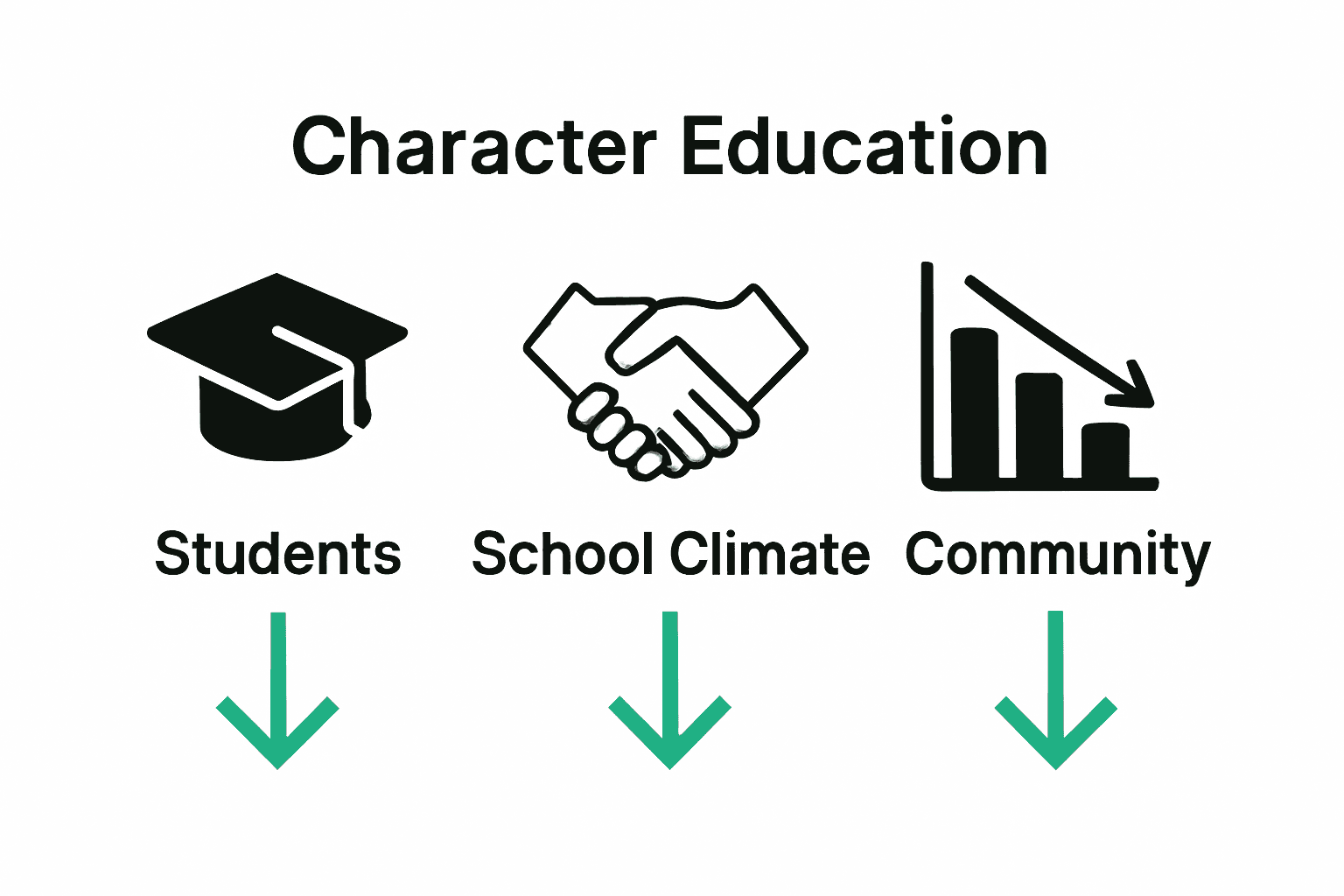
- Benefits For Students, Schools, And Communities
- Challenges, Misconceptions, And Implementation Risks
Defining Character Education and Its Key Elements
Character education represents a systematic approach to teaching students fundamental values that extend beyond traditional academic learning. According to what is character development research, it’s a comprehensive strategy designed to help students develop core moral and ethical principles that guide their behavior and decision-making.
At its core, character education focuses on cultivating essential virtues that create well-rounded individuals. These core values typically include:
- Honesty: Being truthful and transparent in all interactions
- Integrity: Maintaining strong ethical principles
- Respect: Treating others with dignity and understanding
- Responsibility: Demonstrating accountability for one’s actions
As highlighted by research from Study Smarter, character education employs multiple sophisticated techniques to help students internalize these values. These techniques include:
- Direct instruction about ethical principles
- Modeling positive behaviors through educator examples
- Service-learning projects that connect classroom lessons to real-world experiences
- Classroom discussions that encourage critical thinking about moral challenges
“Character education transforms students from passive learners into active, ethically-minded citizens.”
By integrating these comprehensive approaches, schools can create an environment that not only teaches academic content but also nurtures students’ moral development.
 Our guide on character education examples offers deeper insights into practical implementation strategies that educators can use to enhance their character education programs.
Major Approaches and Program Types Explained
Character education encompasses diverse methodological approaches, each targeting specific developmental needs and learning environments. Understanding these different program types helps schools create comprehensive and targeted moral learning strategies.
Skill-Based Training Approaches
One prominent approach is Skillstreaming, an evidence-based social-skills training method that provides structured learning for character development. According to research on character development, this approach focuses on teaching adaptive behaviors through three critical techniques:
- Modeling: Demonstrating positive behavioral examples
- Rehearsal: Practicing new social skills in controlled environments
- Performance Feedback: Providing constructive guidance to reinforce learning
Comprehensive Character Development Programs
Here’s a comparison of major approaches to character education:
| Approach Type | Key Features | Strengths |
|---|---|---|
| Skill-Based Training | Modeling Rehearsal Performance Feedback | Teaches specific social skills Structured and measurable |
| Comprehensive Programs | Curriculum integration School-wide expectations Community service Peer mentorship | Holistic development Promotes school-wide culture |
Beyond skill-based training, character education includes holistic programs that integrate multiple learning strategies. These comprehensive approaches typically involve:
- Classroom curriculum integration
- School-wide behavioral expectations
- Community service opportunities
- Peer mentorship initiatives
“Effective character education transforms learning from an individual experience to a collective journey of moral growth.”
Our comprehensive guide on character education examples offers deeper insights into these multifaceted approaches. By combining different methodologies, schools can create robust programs that address the complex moral and social development needs of students across various age groups and learning contexts.
Integrating Character Education Into School Curriculum
Curriculum integration represents the most powerful strategy for embedding character education into students’ daily learning experiences. According to research from the University of Southern Mississippi, incorporating character lessons directly into academic subjects can dramatically enhance students’ moral development and interpersonal skills.
Strategic Integration Techniques
Effective character education integration involves several sophisticated approaches:
- Cooperative Learning Tasks: Design collaborative assignments that require students to practice virtues like teamwork and mutual respect
- Ethical Discussions: Connect moral lessons to literature, history, and current events
- Reflective Practices: Encourage students to analyze their own behaviors and motivations
Practical Implementation Strategies
Research from the Association for Supervision and Curriculum Development highlights key implementation methods:
- Build a supportive classroom community
- Model character language consistently
- Use role-playing scenarios to explore ethical challenges
- Create opportunities for regular moral reflection
“Character education isn’t an add-on to learning – it’s fundamental to meaningful education.”
Our comprehensive guide on character education pillars provides deeper insights into creating a holistic approach. By thoughtfully weaving character development into existing curriculum, schools can transform learning from mere academic instruction into a powerful journey of personal growth and ethical understanding.
Benefits for Students, Schools, and Communities
Character education delivers profound, multifaceted benefits that extend far beyond traditional academic learning. Research demonstrates significant positive impacts across individual student development, school environments, and broader community dynamics.
Student-Level Benefits
According to studies from Number Analytics, character education programs generate remarkable outcomes for students:
- Academic Performance: Average gains of 11 percentile points in academic achievement
- Emotional Intelligence: Enhanced empathy and improved social interaction skills
- Behavioral Improvement: Reduced disciplinary incidents and increased self-regulation
Systemic School Advantages
Research from Study Smarter highlights the transformative potential of comprehensive character education programs:
- Creating a more positive school climate
- Improving student perception of safety and respect
- Developing stronger interpersonal relationships
- Fostering a collaborative learning environment
“Character education doesn’t just teach values – it fundamentally reshapes educational experiences.”
Learn more about enrichment programs that support character development, which can further amplify these positive outcomes. By investing in holistic character education, schools become powerful engines of personal growth, social cohesion, and community transformation.
Challenges, Misconceptions, and Implementation Risks
Character education is not a one-size-fits-all solution, and schools must navigate potential pitfalls to ensure meaningful moral development. Research from Lux Wisp reveals critical challenges that can undermine even well-intentioned programs.
Common Implementation Risks
Superificial approaches to character education can create significant developmental barriers:
- Behavioral Control: Focusing on compliance instead of genuine ethical understanding
- Reduced Critical Thinking: Programs that dictate values without encouraging nuanced moral reasoning
- Empathy Erosion: Rigid frameworks that limit students’ ability to understand complex ethical scenarios
Strategic Risk Mitigation
To effectively address these potential challenges, schools should:
- Develop dynamic, flexible character education frameworks
- Encourage open dialogue and critical reflection
- Train educators in sophisticated moral teaching techniques
- Regularly assess and adapt program approaches
“Effective character education empowers students to think critically, not just follow rules.”
Our comprehensive guide on character education pillars provides deeper insights into creating robust, nuanced programs. By understanding and proactively addressing implementation risks, schools can transform character education from a potential pitfall into a powerful tool for holistic student development.
Transform Character Education Into Lasting Impact With Engaging Programs
Is your school struggling to make character education come alive for students? Many educators know that teaching values like honesty, respect, and responsibility can feel challenging, especially when trying to move beyond rules and worksheets to real, lasting understanding. The challenges highlighted in the Complete Guide to Character Education in Schools are real: integrating character lessons, promoting empathy, and building a consistent school culture takes more than good intentions. What if you could bring those lessons to life in a way students never forget?

Academic Entertainment helps schools bridge that gap with unforgettable live and virtual character education assemblies. Choose from a wide variety of dynamic programs that spark engagement and reinforce key character pillars through music, drama, magic, and interactive experiences. With over forty years supporting schools nationwide, our platform makes it easy to find assemblies that align with your character education goals. Visit Academic Entertainment now to discover programs that motivate, unify, and inspire your K-12 community. Book your next event today and give your students the gift of meaningful character development.
Frequently Asked Questions
What is character education?
Character education is a systematic approach to teaching fundamental values and moral principles that guide students’ behavior and decision-making beyond traditional academic learning.
What are the key elements of character education?
Key elements typically include honesty, integrity, respect, and responsibility. These values aim to cultivate well-rounded individuals who contribute positively to society.
How can schools integrate character education into the curriculum?
Schools can integrate character education through cooperative learning tasks, ethical discussions connecting moral lessons to various subjects, and reflective practices encouraging students to analyze their own behaviors and motivations.
What are the benefits of character education for students?
Character education has been shown to improve academic performance, enhance emotional intelligence, foster interpersonal skills, and reduce disciplinary incidents, leading to a more positive and safe school environment.
Recommended
- 8 Effective Character Education Examples for Schools – Academic Entertainment
- What is Character Development for Students: Understanding the Basics – Academic Entertainment
- 7 Key Character Education Pillars for Schools – Academic Entertainment
- Character Building, Education, and PBIS School Assemblies – Academic Entertainment